
This is not a small update. Some of it is a policy change. A lot of it is a product change that needs engineering time, and the deadline is a few months away. Most of the coverage so far has listed the clauses. This post groups them into five areas, shows what each one looks like on a phone screen, and names who on the team owns the fix.
The rules cover every e-commerce entity operating in India: marketplaces hosting third-party sellers, inventory-based platforms selling their own stock, and D2C brands selling through their own website or app. If you have a checkout, this applies to you. The full notification is available further down this page.
The 55-second version, on video
The same five categories, in Hinglish, in under a minute. If you would rather watch than read, start here.
The two dates
- 9 September 2026. Amendment rules notified as G.S.R. 789(E), under section 101(2)(zg) of the Consumer Protection Act, 2019.
- 1 January 2027. Rules in force. Anything live on your platform that day must comply, so the practical deadline is your last release before the new year.
The five areas at a glance
One row per area. The right-hand column is the honest size of the job.
| Area | What changes on screen | Owner | Effort |
|---|---|---|---|
| 1. Pricing & search | Discount against the 30-day lowest price, not MRP. Ranking parameters published. Sponsored slots labelled. | Growth + Engineering | Data model |
| 2. Dark patterns & fees | No urgency nudges or pre-ticked add-ons. No platform or convenience fees. Annual self-audit certificate. | Product + Legal | UI + policy |
| 3. Seller & product disclosure | GSTIN, MSME, address, origin and importer on every listing. Returns, warranty and delivery before Buy. | Catalogue + Seller ops | Data model |
| 4. Invoice | Seller name at the platform's font size. Policies restated on the invoice. | Finance + Engineering | Template |
| 5. Grievance | Legal name, address and grievance officer visible. 48-hour acknowledgement, one-month resolution, NCH link. | Support + Legal | SLA + integration |
Effort is our reading of the work involved for a typical mid-sized platform, not anything the rules say. Data model means you probably need to collect or store information you do not have today.
1. Pricing, search and sponsored listings
What the rules say
Discounts. When you announce a price reduction, the prior price shown next to it must be the lowest price that product sold at on your platform in the preceding 30 days. Not the MRP, not a list price.
Search. Ranking now means any relative prominence you give a seller or product, whatever technology does it. Manipulating search results or indexes in response to a user's query is expressly prohibited, and marketplaces must publish the main ranking parameters in descending order of significance, with their relative importance, in plain and intelligible language.
Sponsored listings. Paid placements must be distinctly identified with clear and prominent disclosure. A small grey Ad tag most users scroll past is unlikely to pass.
What it looks like on screen
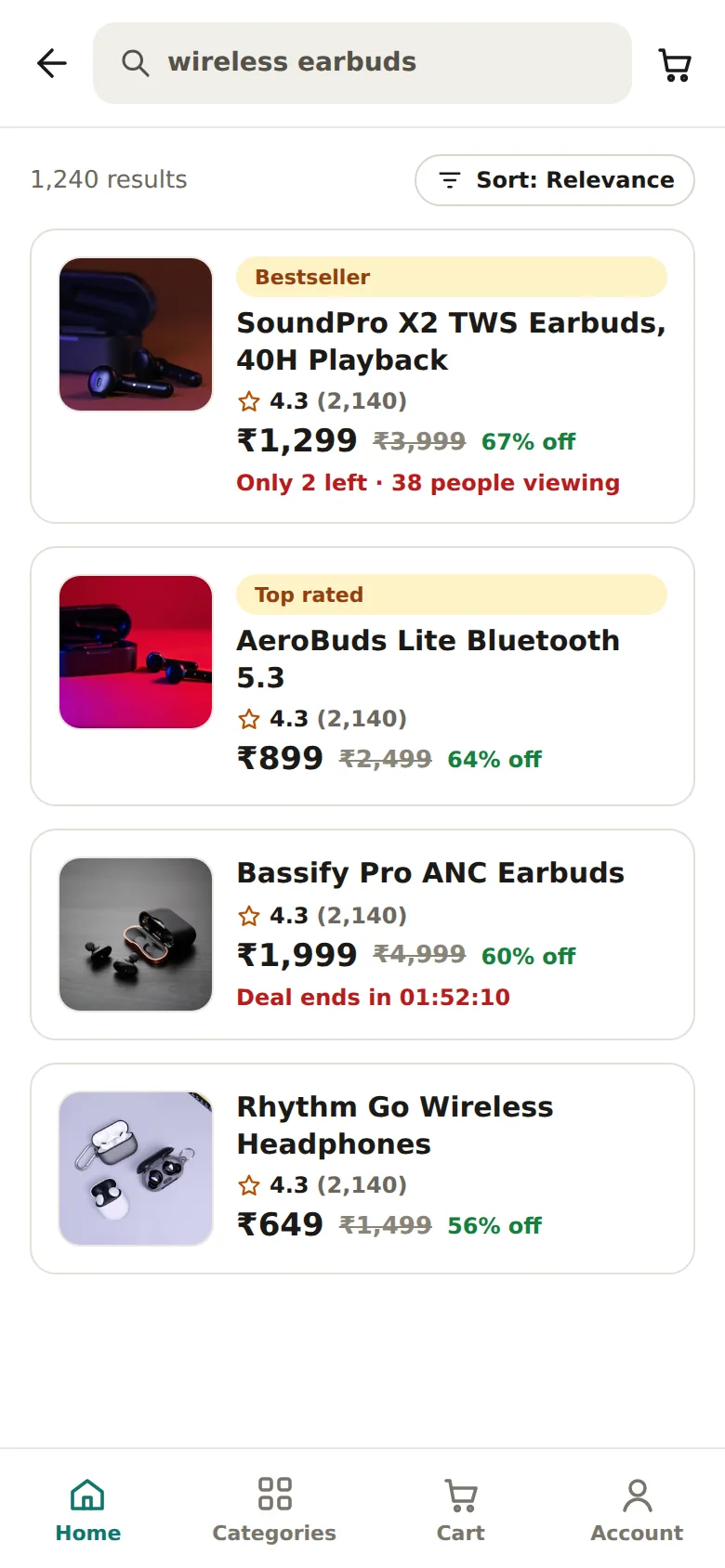
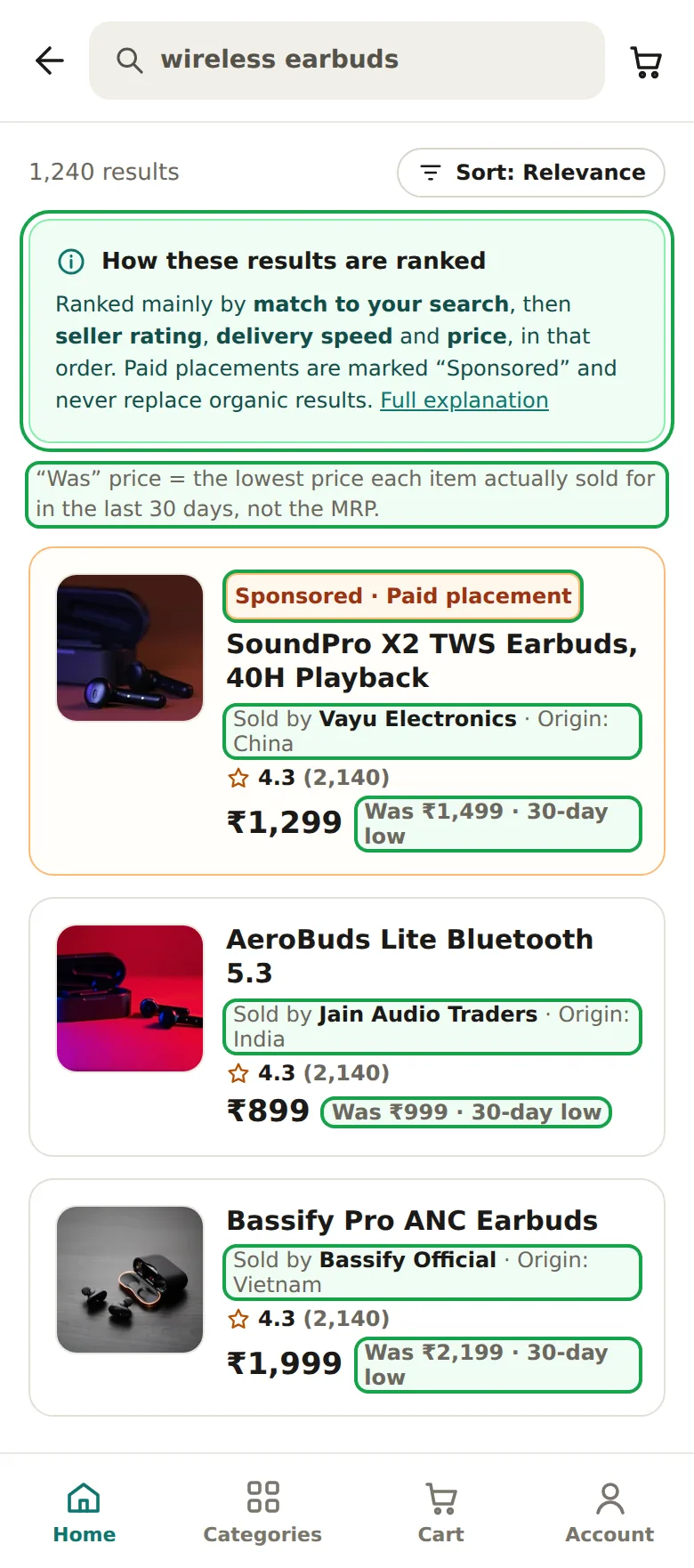
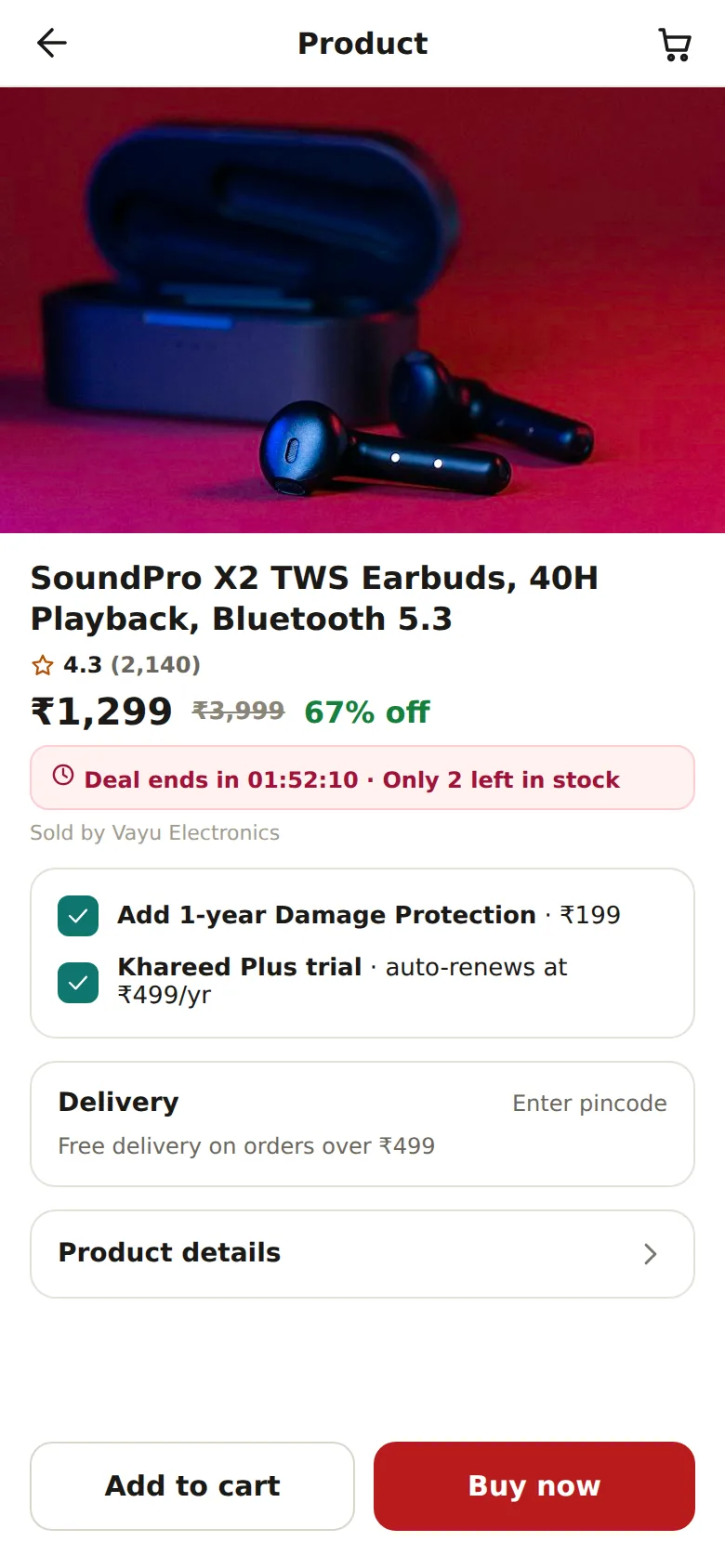
The classic MRP ₹3,999, now ₹1,299, 67% off card is the clearest casualty. If that product sold at ₹1,499 last week, the card has to read ₹1,299, was ₹1,499, and the discount is 13%, not 67%. If your catalogue does not store daily price snapshots, you cannot compute the reference price, and without a reference price you cannot show a discount at all. Owner: pricing, growth and engineering.
2. Dark patterns, fees and consent
What the rules say
The Guidelines for Prevention and Regulation of Dark Patterns, 2023 were guidance. Under the amended rules, complying with them is a requirement, and every e-commerce entity must run a yearly self-audit and prominently display a certificate confirming the platform is free of dark patterns.
Marketplaces can no longer collect bundled fees for services unrelated to the platform; the one carve-out is loyalty or membership programmes and their benefits. Marketplaces also cannot use consumer information to sell goods under a brand sharing the marketplace's name, or advertise sellers as associated with the marketplace, without the consumer's express and affirmative consent.
What it looks like on screen
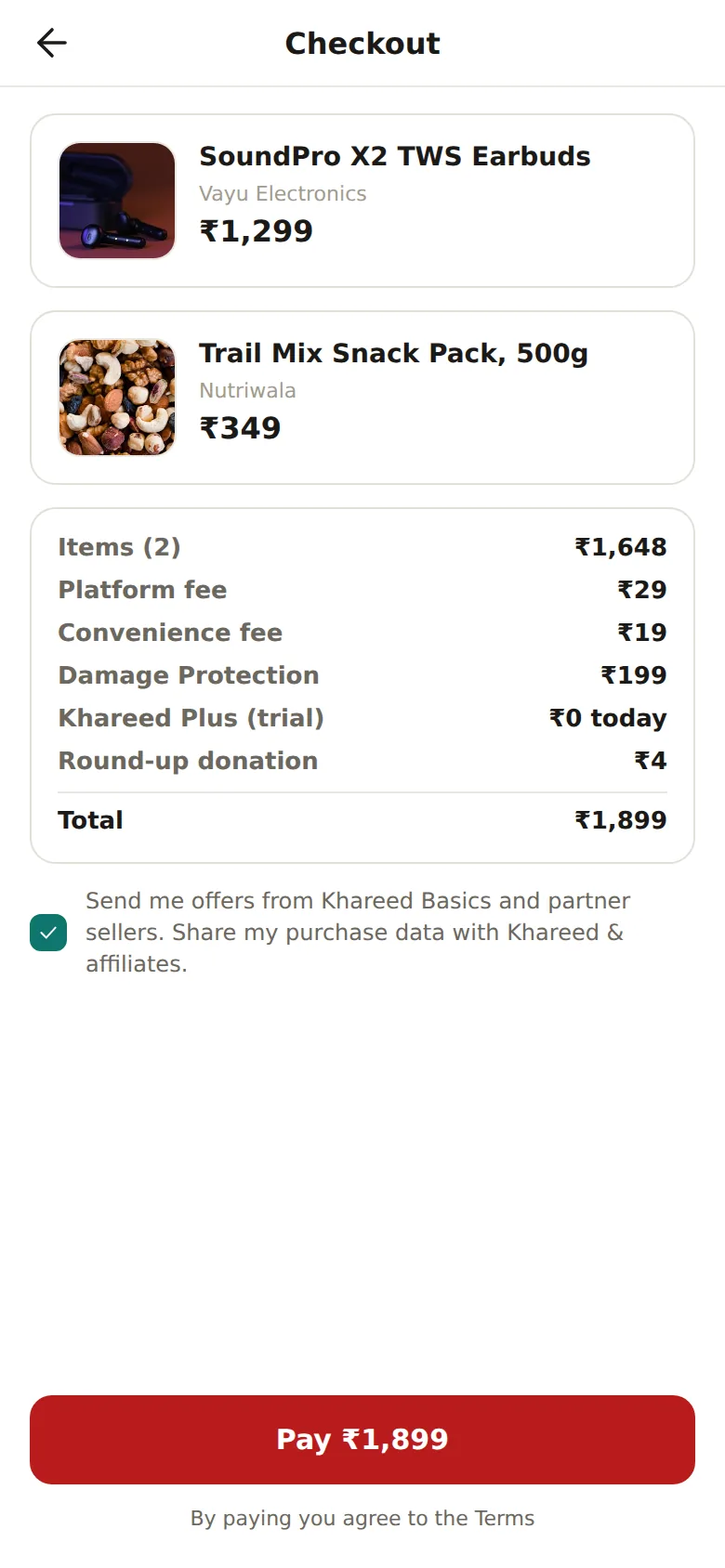
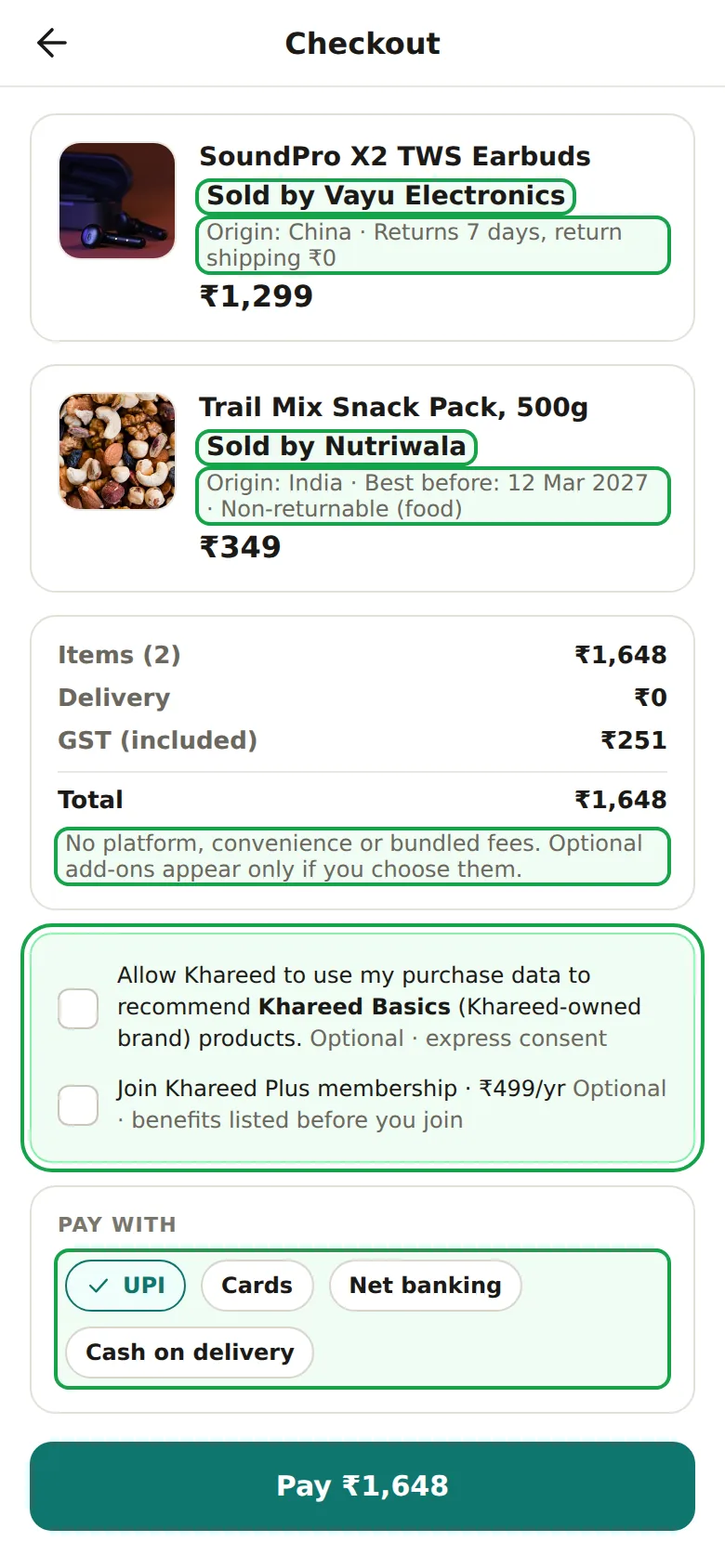
Countdown timers, only 2 left, 38 people are viewing this, pre-ticked insurance, auto-renewing trials and guilt-trip decline buttons all fall under the dark-pattern guidelines. The checkout total should be items plus delivery plus tax. Run the first self-audit before 1 January so the certificate is live on day one. Owner: product, legal and finance.
3. Seller and product transparency
What the rules say
This is the largest set of changes by volume. Marketplaces must provide comprehensive seller information: business name, whether registered or not, address, customer care number, website and email, ratings, and anything else a consumer needs to decide. Sellers must disclose Central Government identification numbers, including GSTIN and MSME registration.
For imported goods, the platform must name the importer and state the full country of origin as the Legal Metrology (Packaged Commodities) Rules, 2011 require. Before purchase, sellers must disclose country of origin, best-before or use-before date (for food, as the FSS Act requires), return, refund and exchange policies, warranties and guarantees, delivery and shipment details, cost of return shipping and modes of payment. After purchase, a consumer who writes in can obtain additional seller information to resolve a dispute.
What it looks like on screen
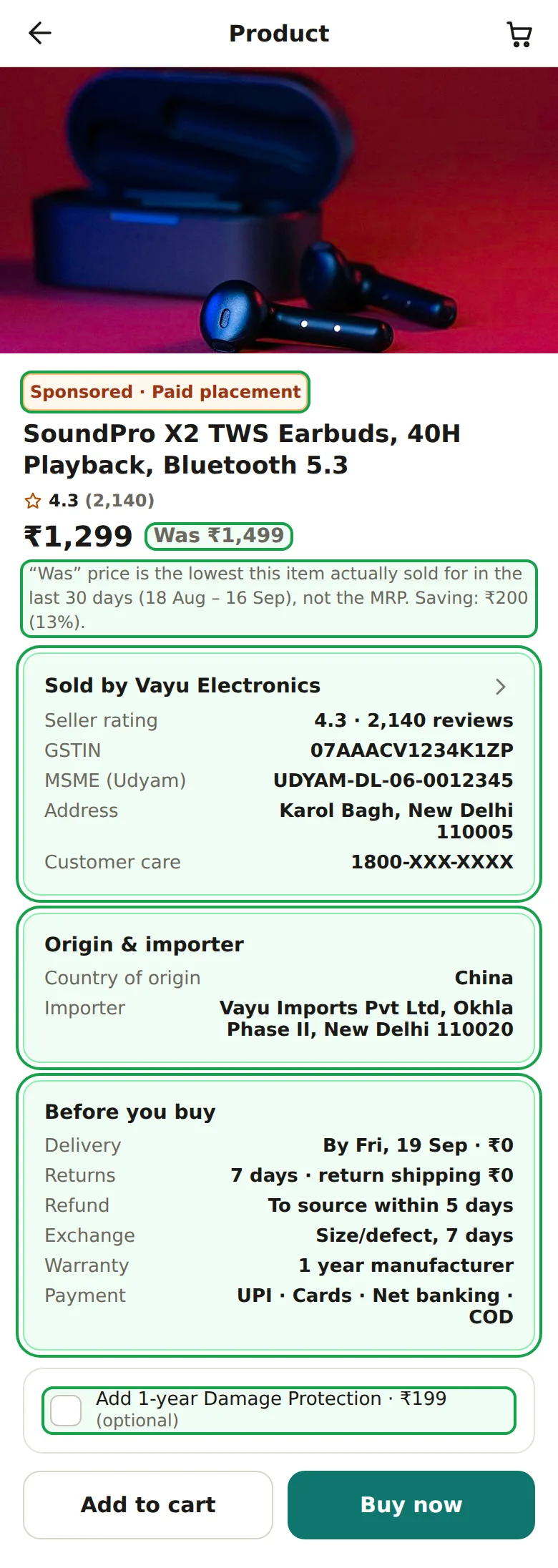
This area is the most likely to take longest because it depends on data you may not have collected yet. Your seller onboarding form needs new mandatory fields and existing sellers need re-verifying against them. Start it first. Owner: catalogue and seller operations.
4. Invoice and post-purchase
What the rules say
The seller's name must be displayed clearly and prominently on the invoice, in the same font size as the e-commerce entity's name. The substituted Rule 7(1)(a) requires accurate consumer-facing disclosure of return, refund and exchange policies, best-before dates, warranties, delivery details, cost of return shipping, payment modes and the grievance mechanism, which in practice means the product-page disclosures carry through to the order confirmation and invoice.
What it looks like on screen
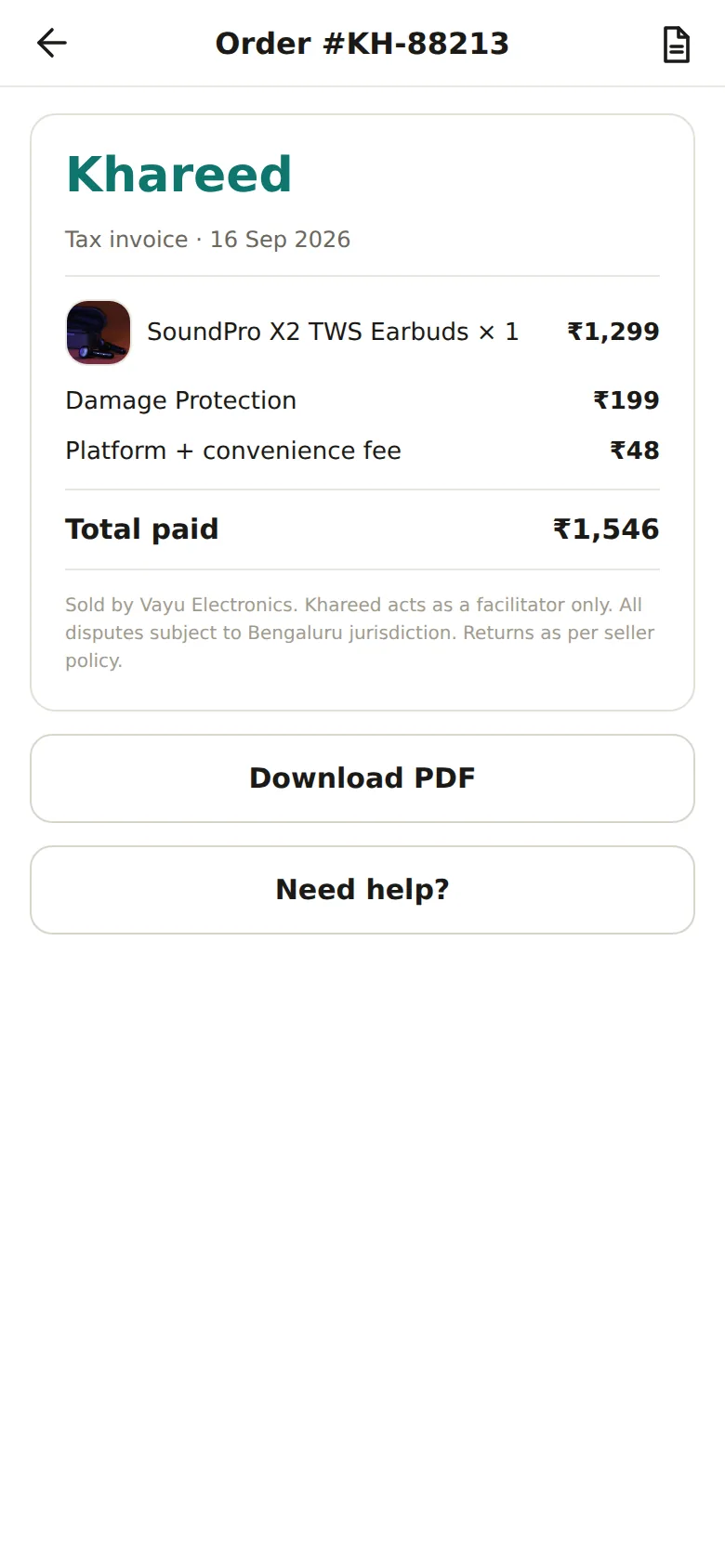
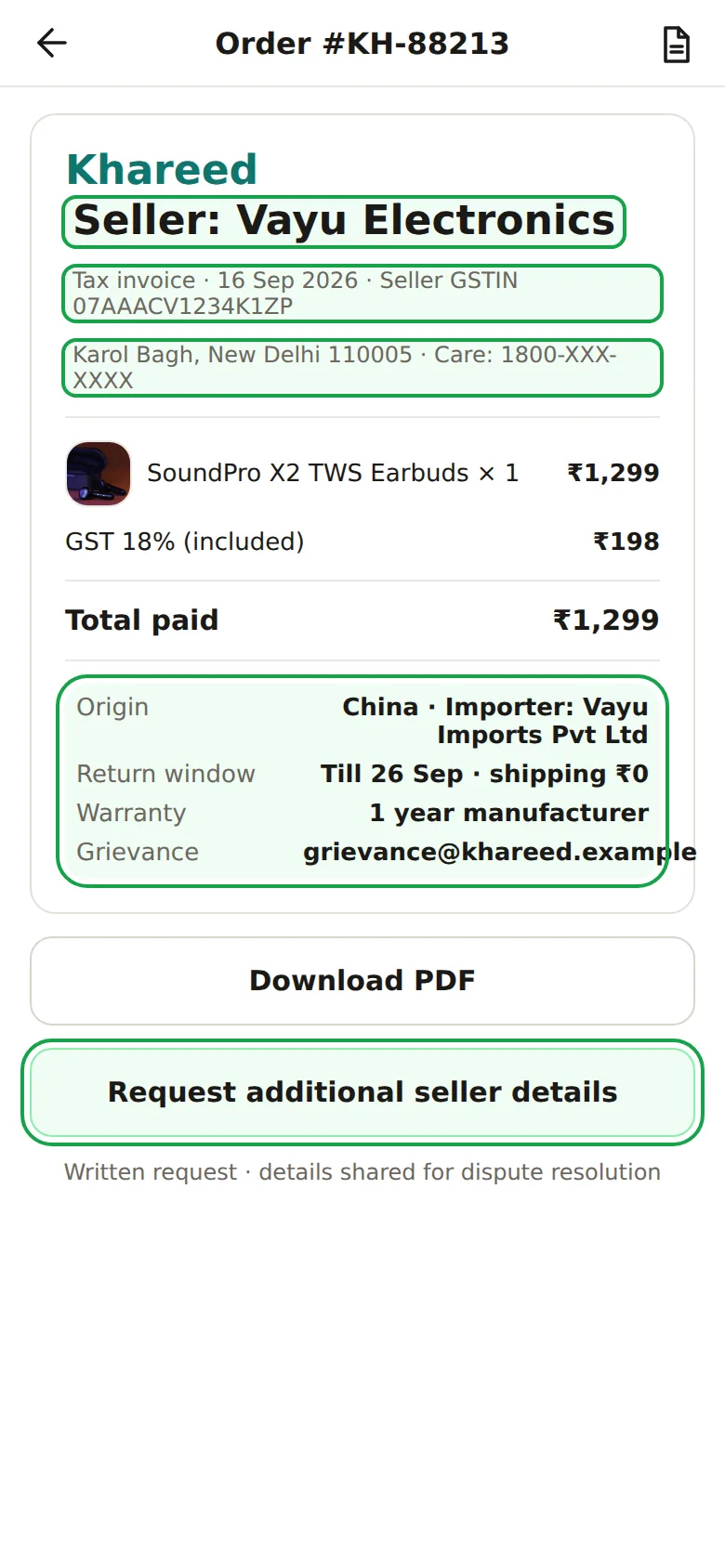
Yes, font size is now a compliance item. This is a template change plus a data-mapping change so the seller's GSTIN and address flow into the document. Owner: finance and engineering.
5. Grievance redressal and accountability
What the rules say
Every e-commerce entity must prominently display its legal name, the principal geographic address of its headquarters and all branches, its website details, and the e-mail, landline and mobile numbers of both customer care and the grievance officer. The grievance officer must acknowledge a complaint within 48 hours, give the consumer a copy of the complaint as recorded, and redress it within one month. All entities must join the Central Government's National Consumer Helpline convergence process.
What it looks like on screen
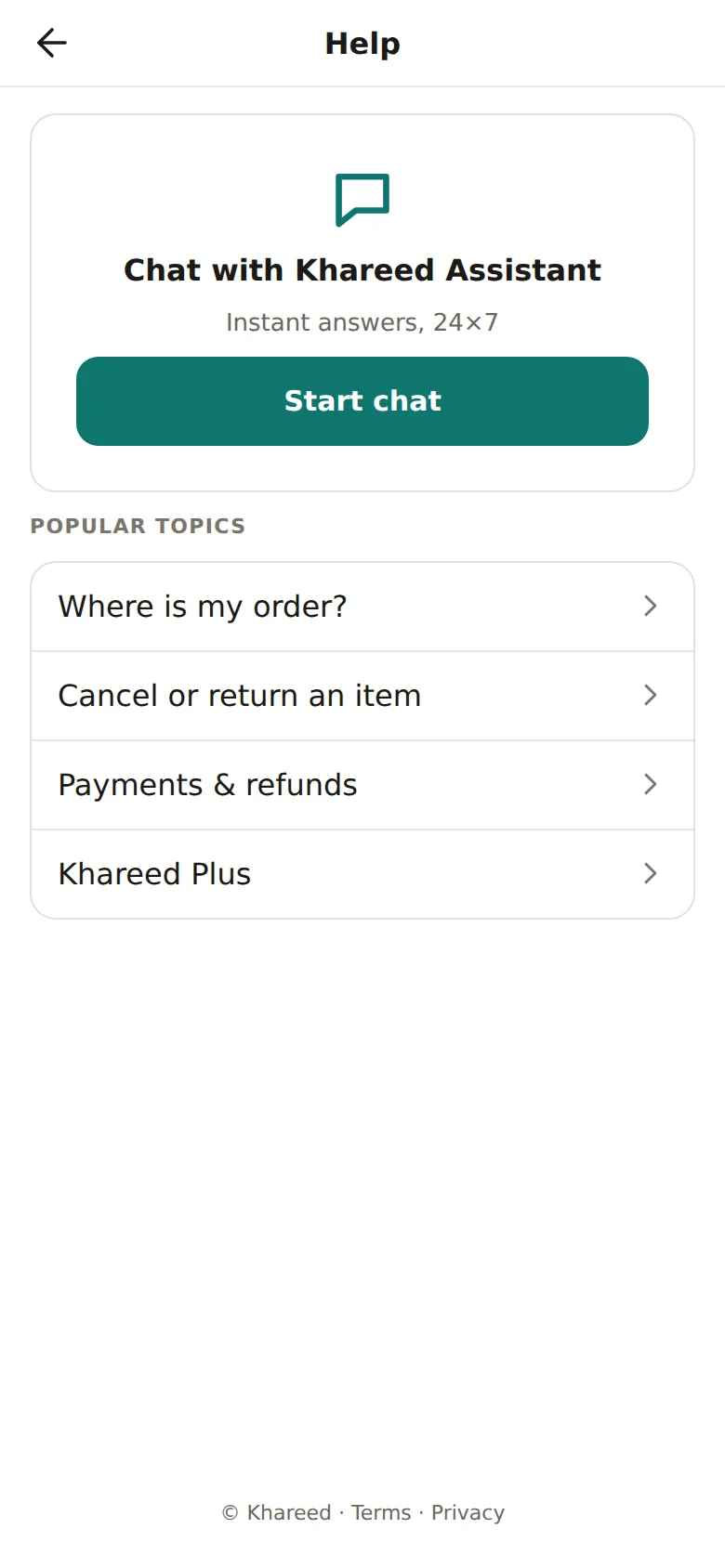
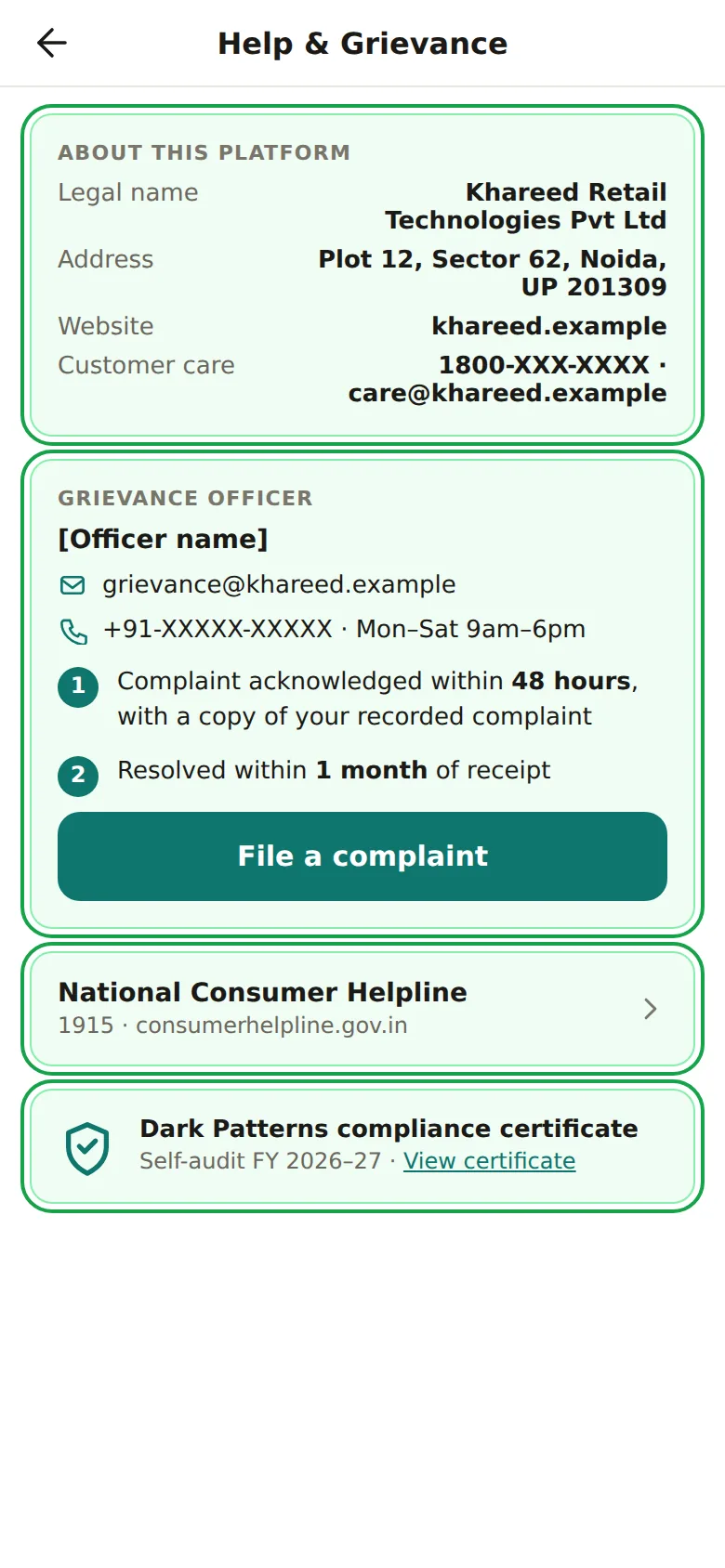
The 48-hour acknowledgement is an SLA your ticketing system has to enforce, and the copy-of-complaint clause means every complaint needs an automatic confirmation that restates what the consumer said. Start NCH convergence early; it involves an external process. Owner: support and legal.
Download the official gazette notification
Consumer Protection (E-Commerce) (Amendment) Rules, 2026, G.S.R. 789(E), Gazette of India Extraordinary, 9 September 2026. The full five-page notification, Hindi and English, exactly as published.
- The substituted definition of ranking and the new search-manipulation clause
- Rule 4: platform disclosures, the 48-hour and one-month grievance timelines, importer and country-of-origin duties
- Rules 5 and 6: seller information, the prior-price rule, invoice font size, bundled fees, private-label consent, GSTIN and MSME
- Rule 7: the consumer-facing disclosure clause as substituted
This is a public document published in the Gazette of India. Official updates are on egazette.gov.in .
A realistic timeline
Roughly three months of working time before the last pre-deadline release.
- 1
October: data and policy
Add GSTIN, MSME and importer fields to seller onboarding and start collecting them from existing sellers. Begin storing daily price snapshots per SKU. Decide what happens to platform-fee revenue. Draft the ranking-parameters disclosure and the grievance policy.
- 2
November: product and templates
Ship the seller card, origin block and before-you-buy list on product pages. Rebuild the discount display against the 30-day low. Add sponsored labels and the ranking explanation to search. Remove urgency elements and pre-ticked add-ons from checkout. Update the invoice template.
- 3
December: support, audit and sign-off
Rebuild the help page with legal details and the grievance officer. Configure the 48-hour acknowledgement in your support tool. Run the dark-pattern self-audit and publish the certificate. Complete National Consumer Helpline convergence. Release before the holiday freeze.
If you are a small D2C brand on a hosted platform, most of the checkout and invoice work is a theme change and a settings change. The seller-disclosure clauses still apply to you as the seller.
Want the screen-by-screen checklist?
We built a before-and-after mockup for every screen in this post while working through the rules. Members at Hoblix get an hour with us on their storefront: which screens are exposed, what the seller-onboarding form needs, and how to sequence the work before 1 January. We run our own bookings and invoicing under consumer law, so we are not advising from the outside.
Build. Connect. Grow.
The storefront review comes with workstation and cabin memberships. It is not part of the day pass, though a day pass is the easiest way to see the floor first.
Status check, September 2026
- Notified: G.S.R. 789(E), 9 September 2026, Department of Consumer Affairs. Effective 1 January 2027.
- Amends: the Consumer Protection (E-Commerce) Rules, 2020, G.S.R. 462(E) of 23 July 2020.
- Plan on: the rules being live from 1 January. Nothing in the notification provides a transition period after that date.
Frequently asked questions
Each answer names the rule it comes from. Where the gazette is silent, the answer says so.
What exactly is the prior price I have to show next to a discount?
The lowest price of that good or service in the thirty days before you announce the reduction. That is the explanation to the new sub-rule inserted after Rule 4(11). The MRP is not mentioned; only the 30-day low qualifies as the prior price.
Can I still print the MRP on the listing?
The amendment does not stop you displaying the MRP; other law, such as the packaged-commodity rules, may require it. What it does say is that when you announce a price reduction, the prior price shown alongside must be the 30-day low. So the MRP can appear, but it cannot be the figure the discount is measured against.
What if a product is new and has no 30-day sales history?
The gazette does not address this. Read strictly, there is no lowest price in the preceding thirty days to show, so a price-reduction announcement has nothing lawful to anchor to. The conservative reading is to show the selling price without a discount claim until a 30-day history exists. Take counsel's view before relying on anything looser.
Are membership or loyalty fees banned?
No. Rule 5(7) bars a marketplace from collecting bundled fees for services unrelated to the platform, and its proviso expressly excludes any loyalty or membership programme and any benefit, service, offer or incentive provided under it.
Does the sponsored-listing rule apply to me if I only sell my own products?
The clause says every e-commerce entity shall ensure sponsored listings are distinctly identified with clear and prominent disclosures. It is not limited to marketplaces. If you promote a listing on your own site as a paid placement, label it. Where nothing is paid for, there is no sponsored listing to label.
Who has to publish the ranking explanation?
Rule 5(3)(f) applies to marketplace e-commerce entities: an explanation of the main parameters, in descending order, that determine ranking of goods or sellers, and their relative importance, in an easily and publicly available description drafted in plain and intelligible language. The separate ban on misleading users by manipulating search results, Rule 4(11)(c), applies to every e-commerce entity.
Is the 48-hour acknowledgement a working-hours clock?
Rule 4(5) says forty-eight hours from receipt and one month from receipt, with no reference to working days. Treat both as calendar time unless counsel advises otherwise.
What counts as express consent for using customer data to push my private label?
Rule 5(6) requires the express and affirmative consent of the consumers whose information is used, before the marketplace uses it to sell goods under a brand common with its own, or to promote a seller as associated with it. A pre-ticked box is not affirmative; an unticked box the customer chooses to tick is the safe pattern.
Does the GSTIN or MSME number have to be on the product page?
Rule 6(5)(j) makes it a seller disclosure: any identification number issued by the Central Government, including GSTIN or MSME registration. The rule does not prescribe where on the page it appears, only that the seller discloses it on the platform.
What is the penalty?
The amendment sets no penalty schedule of its own. The rules are made under section 101 of the Consumer Protection Act, 2019 and are enforced through that Act, the Central Consumer Protection Authority and the consumer commissions. Plan around being compliant on 1 January, not around a fine amount.
A note on what this is. This page is a plain-English reading of the Consumer Protection (E-Commerce) (Amendment) Rules, 2026, G.S.R. 789(E), written for founders and product teams. It is not legal advice, and Hoblix has no role in enforcing the rules; confirm your own obligations with counsel. The mockups use a fictional brand and do not depict any real platform. Related reading: UPI MDR from 15 October, explained for merchants and Startup India schemes.
Last reviewed 26 September 2026. We will update this page if the effective date or the rules change.