
Most of the coverage stopped at “UPI is no longer free.” That is true for a specific slice of transactions and misleading for everyone else. NPCI's own figure is that payments up to ₹2,000 are more than 95% of merchant UPI volume; the fee lands on the businesses that take large tickets, and it lands on the full amount, not just the part above the threshold.
If you run a small business, a freelance practice or an early-stage startup, the question is not whether UPI is free. It is which of your collections cross ₹2,000, and whether they need to. Every figure below comes from NPCI's FAQ of 15 September 2026, which is available further down this page.
The 50-second version, on video
The same four exemptions, in Hinglish, in under a minute. If you would rather watch than read, start here.
What was decided, and by whom
Two documents matter. The first is Gazette notification S.O. 5067(E) of 14 September 2026, which amends the zero-MDR protection in force since January 2020 under Section 10A of the Payment and Settlement Systems Act. The 2019 notification barred any charge on RuPay debit and UPI; the new one narrows that protection to two things: RuPay debit cards with no ceiling, and UPI transactions up to ₹2,000.
The second is NPCI's FAQ of 15 September, which sets the rate: 0.4% on person-to-merchant UPI payments above ₹2,000, capped at ₹300 for transactions of ₹75,000 and above, effective 15 October 2026. The gazette lifts the protection; NPCI sets the price. The operational parameters and category caps are decided by the UPI and Services Steering Committee, which NPCI heads.
NPCI's stated reason is that running UPI costs around ₹20,000 crore a year, that government subsidy was bridge funding rather than a permanent model, and that the MDR is distributed only within the UPI ecosystem, meaning the remitter bank, the acquiring bank, the PSP bank and the app, to fund resiliency, cybersecurity and customer service. None of it goes to the government. Whether you find that persuasive does not change what your acquiring bank will deduct from 15 October.
How the fee is actually calculated
The rate is 0.4% of the full transaction value, applied when the value exceeds ₹2,000. It is not 0.4% of the excess. At ₹75,000 the fee reaches ₹300 and stops growing. These are NPCI's own worked examples.
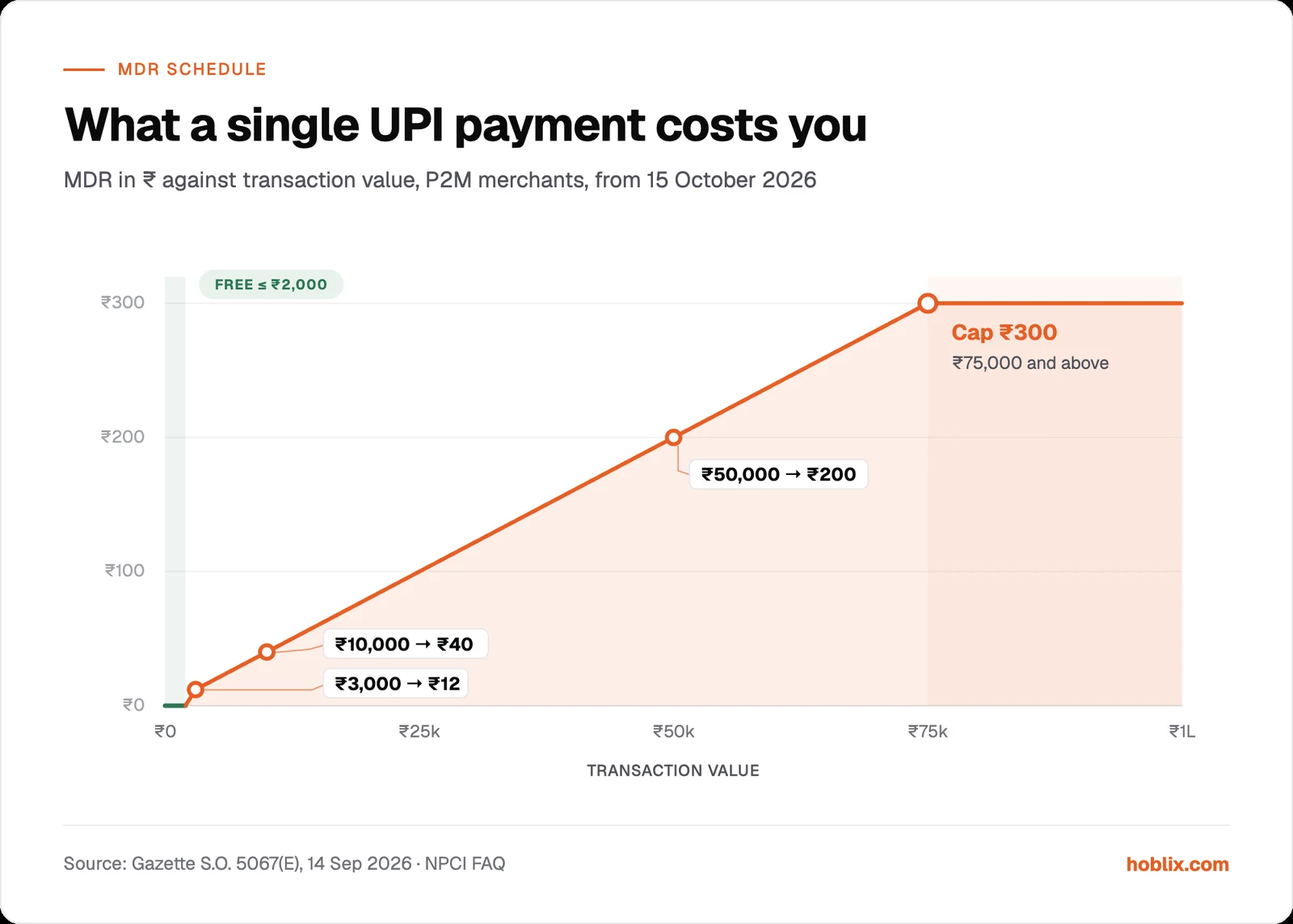
Source: NPCI, FAQs — Merchant Discount Rate (MDR) on Select UPI (P2M) Transactions, 15 September 2026, Q35. The ₹10,000 point is ours, by the same formula.
Every rate in the framework
Five rows are nil. Read those before the one that is not.
| Transaction type | Value | Merchant MDR |
|---|---|---|
| Any person-to-merchant (P2M) UPI payment | Up to ₹2,000 | Nil |
| Small merchant (P2PM), up to ₹1 lakh a month via UPI QR | Any amount | Nil |
| Person-to-person transfer, including self-transfer | Any amount | Nil |
| UPI AutoPay / recurring mandate | Any amount | Nil |
| RuPay debit card | Any amount | Nil |
| Railways, telecom, insurance, fuel, electricity, water, piped gas | Above ₹2,000 | Flat ₹5 |
| Education fees | Above ₹2,000 | Flat or capped (concessional) |
| Mutual funds, securities, brokers | Above ₹2,000 | 0.02%, cap ₹300 |
| Standard P2M UPI payment | Above ₹2,000 | 0.4%, cap ₹300 |
| RuPay credit card / credit line on UPI | Any amount | Credit card rules apply |
Sources: NPCI FAQ Q3, Q16, Q22–24, Q31–33, Q36–42; Gazette S.O. 5067(E) for RuPay debit. Credit card MDR is 1.5–2.5% and debit card MDR up to 0.9%, per NPCI's own comparison in Q4.
The four ways a small business stays at zero
These are not loopholes. Each is a category the gazette or NPCI's framework explicitly leaves at nil. The work is in setting your collections up so that your transactions fall into them.
Stay classified as a small merchant (P2PM)
A P2PM merchant is a small vendor receiving up to ₹1 lakh a month through UPI QR directly into a bank account. Every P2PM transaction is MDR-free regardless of size. NPCI's FAQ says in terms that a payment above ₹2,000 does not impose a charge on a P2PM merchant. No GST registration is needed to qualify, and you do not have to change your QR stand or soundbox.
Worth knowing: The trigger is official: inward UPI credit above ₹1 lakh a month for three consecutive months moves you to the P2M category. If you sit near the line, watch it.
Ask for RuPay debit on large bills
The gazette notification that lifted the zero-MDR protection from UPI above ₹2,000 kept it for RuPay debit cards with no ceiling. A ₹40,000 RuPay debit tap costs you nothing; the same on UPI costs ₹160, and on Visa or Mastercard debit up to 0.9%.
Worth knowing: One sign at the counter. Every public-sector bank and most private banks issue RuPay debit as standard.
Move invoices above ₹2,000 to bank transfer
MDR is a merchant-acquiring charge. A NEFT, IMPS or RTGS transfer into your current account is not acquired by anyone, so no MDR applies. Put your account number and IFSC on every invoice above ₹2,000 and keep UPI QR for walk-in and small-ticket collections.
Worth knowing: Collect into a business account, not a personal VPA. Routing business income through a personal UPI ID creates a GST reconciliation problem that costs more than 0.4%.
Put recurring billing on UPI AutoPay
UPI mandates carry no prescribed MDR at any value. NPCI's FAQ lists utility bills, OTT subscriptions and recurring investments, and the exemption is by rail, not by category. If you collect the same amount from the same customer every month (memberships, retainers, rent, EMIs, tuition), set up a mandate through your gateway instead of sending a payment link.
Worth knowing: This is the one that matters for a business like ours. A Hoblix workstation is ₹4,999 a month plus GST, above the threshold on every payment. On a mandate the fee is zero. Cashfree, Razorpay, PhonePe and Paytm all support mandate creation.
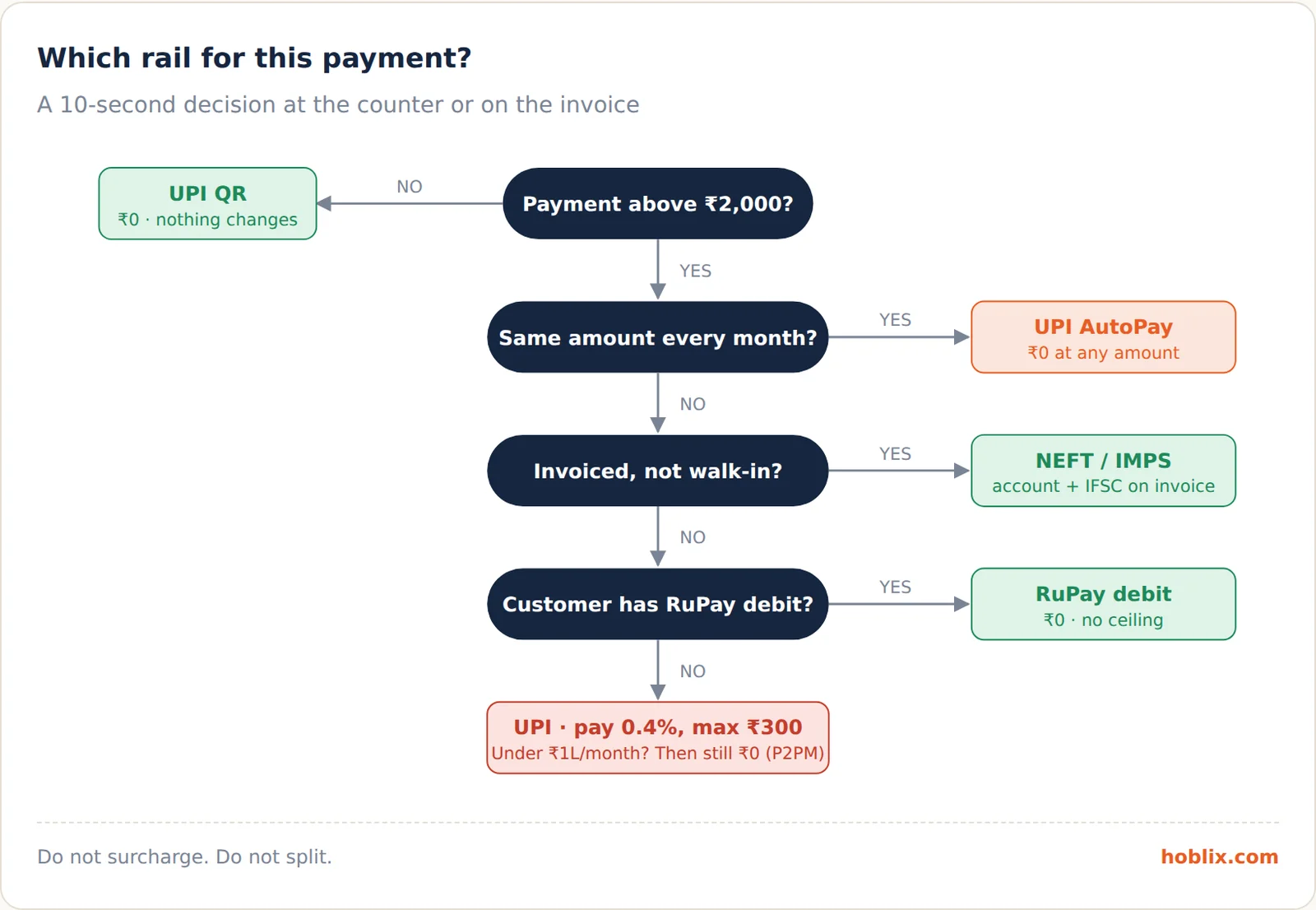
Which rail for this payment?
A ten-second decision at the counter or on the invoice. Print it and stick it near the QR stand.
What does not work
Do not split bills as a policy
Two ₹2,000 payments for a ₹4,000 bill keeps both under the threshold. An occasional customer split is nobody's concern; a counter policy of splitting is the pattern aggregators flag as structured transactions, and a flagged merchant account is a far larger problem than ₹16.
Do not surcharge
NPCI's FAQ is explicit: merchants cannot pass MDR on to customers, and UPI apps cannot add platform fees. A "0.4% UPI fee" line on a bill is a violation.
Do not push credit on UPI
RuPay credit cards and credit lines on UPI sit outside this framework, and inside standard credit card MDR, which NPCI's own FAQ puts at 1.5% to 2.5%. Moving customers to credit does not reduce your cost.
Download the official NPCI FAQ on UPI MDR
NPCI's FAQs — Merchant Discount Rate (MDR) on Select UPI (P2M) Transactions, 15 September 2026. All 42 questions, exactly as published.
- The rate, the ₹2,000 threshold and the ₹300 cap, with NPCI's worked examples
- The P2PM small-merchant exemption and the three-month reclassification rule
- Consumer, P2P, AutoPay and platform-fee positions in NPCI's words
- Flat ₹5 categories, capital-market rates and the credit-on-UPI carve-out
This is a public document published by NPCI. Official updates are on npci.org.in .
What to do before 15 October
In order of impact.
- 1
Pull three months of UPI collections and sort by ticket size
Count the payments above ₹2,000 and total them. For most small businesses the annual cost lands in the hundreds to low thousands. Know your number before you change anything.
- 2
Check your merchant tier
Under ₹1 lakh a month? Confirm with your bank or QR provider that you are on P2PM. If you were upgraded earlier and volume has since dropped, ask whether you can be reclassified.
- 3
Move recurring collections to UPI AutoPay
Anything billed monthly at the same amount goes on a mandate. It is the largest and most permanent saving, so do it first.
- 4
Put bank details on invoices above ₹2,000
Account number and IFSC on the invoice; UPI QR for everything under the threshold.
- 5
Add a RuPay debit sign if you have a card terminal
Costs nothing and catches the large walk-in payments that cannot go by bank transfer.
- 6
Do not surcharge, and do not split
Both turn a ₹12 problem into a merchant-account problem.
We'll set your collections up. It costs you nothing.
Members at Hoblix get an hour with us on their payment stack: which transactions cross the threshold, whether the merchant tier is right, and how to move recurring billing onto mandates through Cashfree or whichever gateway they already use. We run our own collections under the same rules, so we are not advising from the outside.
Build. Connect. Grow.
The collections review comes with workstation and cabin memberships. It is not part of the day pass, though a day pass is the easiest way to see the floor first.
Status check, September 2026
- Notified: Gazette S.O. 5067(E), 14 September 2026. NPCI FAQ published 15 September. Effective 15 October 2026.
- Contested: a Supreme Court petition challenges the framework on the ground that the 0.4% rate is in NPCI's circular and press material, not in the gazette itself. No stay has been reported.
- Pending: a dedicated fund for small-merchant onboarding and incentives, with the detailed framework to be finalised with the RBI within three months.
- Plan on: the fee being live from 15 October. Your acquiring bank or aggregator will apply it to settlement whatever the petition does later.
Frequently asked questions
Will customers pay more for UPI from 15 October 2026?
No. NPCI's FAQ says UPI continues without any cost to consumers, person-to-person transfers stay free for both payer and beneficiary at any amount, and UPI apps are restricted from levying platform fees. The MDR is charged to the merchant and deducted from settlement; merchants cannot pass it on.
Does the 0.4% apply to the whole amount or only the part above ₹2,000?
The whole amount. NPCI's worked example gives a ₹3,000 purchase as ₹12 of MDR, which is 0.4% of ₹3,000, not of the ₹1,000 above the threshold.
What is the maximum MDR on one UPI transaction?
₹300. The 0.4% rate reaches ₹300 at ₹75,000 and is capped there, so a ₹1,00,000 payment costs ₹300 rather than ₹400.
I receive under ₹1 lakh a month on my UPI QR. Does this apply to me?
No, provided you are classified as a P2PM small merchant. P2PM merchants receiving up to ₹1 lakh a month through UPI QR keep zero MDR at any transaction size, and GST registration is not required to qualify. Banks move a merchant to P2M only after inward UPI credit exceeds ₹1 lakh a month for three consecutive months.
Is UPI AutoPay really exempt at any amount?
Yes. NPCI's FAQ states that automated recurring standing instructions, meaning UPI Mandates or AutoPay, do not carry prescribed MDR transaction charges, with utility bills, OTT subscriptions and recurring investments given as examples.
Are RuPay debit cards still free for merchants?
Yes. The Gazette notification S.O. 5067(E) of 14 September 2026 continues the zero-MDR protection for RuPay debit cards with no value ceiling. Visa and Mastercard debit are not covered and carry MDR of up to 0.9%.
Can I split a large bill into payments under ₹2,000?
A customer can, and you cannot stop them. You should not adopt it as a practice: payment aggregators monitor for structured transactions, and a pattern of same-customer, same-minute payments just under the threshold risks your merchant account.
What about RuPay credit cards on UPI?
Credit-linked UPI payments, that is RuPay credit cards and pre-sanctioned credit lines, operate under separate credit product rules, not this MDR framework. They follow standard credit card guidelines, which NPCI's FAQ puts at 1.5% to 2.5%, so they are more expensive for you, not less.
Do I need to change my QR code or soundbox?
No. NPCI's FAQ says existing QR infrastructure continues to work normally and merchants do not need to replace, re-register or alter their QR stands or soundboxes. The change is in what your acquiring bank deducts from settlement, not in the QR.
Where does the MDR go?
It is distributed among the UPI ecosystem (the remitter bank, the acquiring bank, the payment service provider bank and the UPI app), not to the government. NPCI puts the cost of running UPI at around ₹20,000 crore a year and has also announced a dedicated fund, to be detailed with the RBI within three months, to subsidise onboarding and incentives for small merchants.
A note on what this is. This page is a plain-English reading of Gazette notification S.O. 5067(E) and NPCI's public FAQ of 15 September 2026, written for founders and small business owners. It is not legal, tax or financial advice, and Hoblix has no role in setting or collecting MDR. Rates and merchant tiers are applied by your bank or payment aggregator; confirm your own classification with them. Related reading: Startup India schemes and the Delhi Startup Policy.
Last reviewed 23 September 2026. We will update this page if the rate, the cap or the exemptions change.